Short-Term Funding: When Bridging Finance Makes Sense
Short answer: bridging finance is short-term funding that covers a gap between money going out and money coming in. It makes sense when the gap is temporary and you know where the repayment will come from, such as a customer invoice, a contract payment or the busy season. It does not fix a business that loses money every month.
Last week we built a 13-week cash flow forecast. If that forecast shows a dip in week 6 and plenty of cash again by week 10, short-term funding can carry you across the gap.
When bridging finance makes sense
A large order needs stock or materials first. You pay suppliers now and the customer pays you in 30 or 60 days.
Customers pay on long terms. Your invoices are sound, but the cash arrives after salaries and SARS are due.
A seasonal dip. Guesthouses, restaurants and retailers often carry fixed costs through quiet months before the busy season.
A one-off opportunity. Equipment, a bulk discount or a new contract that pays for itself within months.
In each case the repayment comes from money you can already see in your forecast.
When it does not
The business runs at a loss every month and the funding only delays the problem.
There is no clear source of repayment within the term.
The funding would pay for ordinary running costs month after month, rather than a gap.
In these cases the better first step is to look at prices, costs and payment terms. See our 10 ways to improve cash flow.
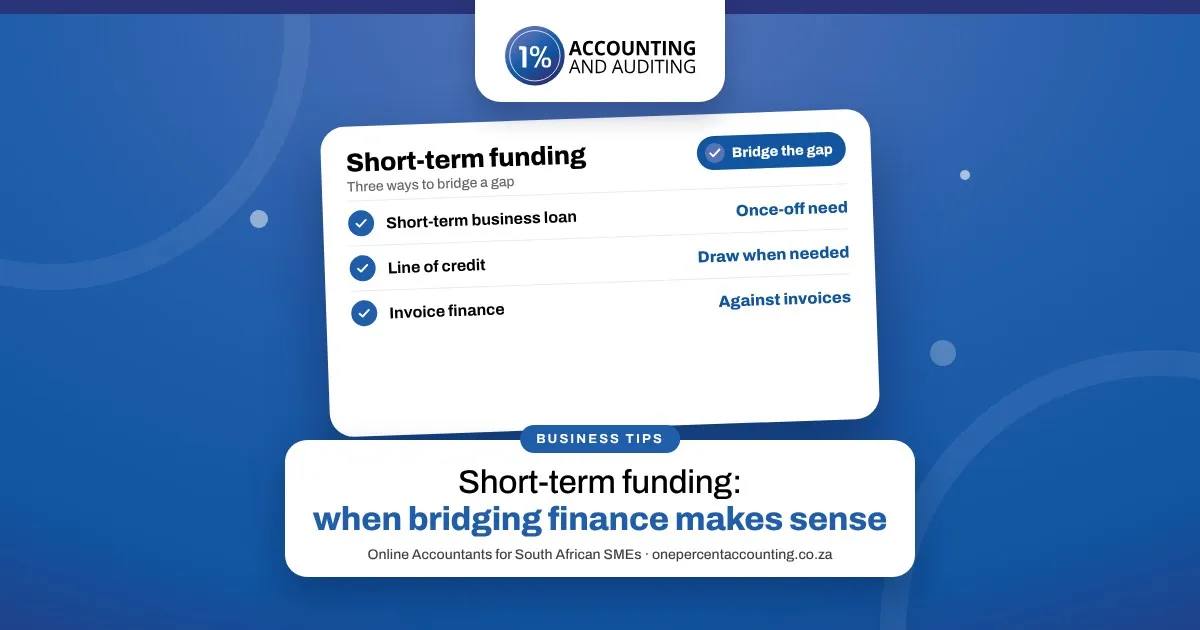
The three types of short-term funding
Type | How it works | Suits |
|---|---|---|
Short-term business loan | A set amount, repaid over an agreed period | A once-off need, such as stock for a large order |
Line of credit | A revolving facility you draw on when you need it, paying only on the amount used | Gaps that come and go through the year |
Invoice finance | An advance against unpaid customer invoices, repaid when the customer pays | Customers on 30-, 60- or 90-day terms |
Five questions to ask before you sign
What is the total cost? Add every fee and the interest, then compare it with the profit the funding makes possible.
When and how do I repay? Check the repayment dates against your cash flow forecast.
What if I settle early? Ask whether early settlement lowers the cost.
Is there security or a personal surety? Know what you are signing for.
What happens if a customer pays late? Especially with invoice finance, ask how a late payment is handled.
Interest on overdrafts and many business loans is linked to the prime rate, now 10.75%. See what the prime rate rise costs your business.
What lenders look at
Lenders decide faster when your numbers are in order: reconciled books, recent bank statements, VAT and tax returns up to date, and a clear picture of business turnover and trading history.
Bridgement, the lender we refer clients to, lists these requirements on its application: a business registered in South Africa, monthly business turnover of R80,000 or more, at least six months of trading history, and bank statements or accounting data such as a Xero file. Bridgement lists funding of up to R10 million for approved businesses, with repayment periods of 1 to 24 months depending on the product and the business.
Apply through our Bridgement Finance page
Registered South African businesses can apply for a short-term loan, a line of credit or invoice finance through our Bridgement Finance page. One Percent Accounting is a Bridgement referral partner. Bridgement is the lender, runs its own credit assessment and sets the terms of any finance it offers.
Frequently asked questions
What is bridging finance?
Short-term funding that covers a temporary gap between money going out and money coming in, repaid from a payment you expect, such as a customer invoice.
How long does bridging finance last?
It is short term, usually months rather than years. Bridgement lists repayment periods of 1 to 24 months, depending on the product and the business.
What do I need to apply for short-term business funding?
Usually recent bank statements or accounting data, proof that the business is registered, and up-to-date books. Bridgement also asks for at least six months of trading and monthly business turnover of R80,000 or more.
Is invoice finance a loan?
It is an advance against invoices your customers have not paid yet. You repay it when the customer pays.
Will my customers know I use invoice finance?
Bridgement says it does not require you to tell your customer. Check the terms of any offer before you sign.
Related guides
Books that are ready when you need funding
Our team keeps your bookkeeping, VAT and tax returns up to date in Xero, so your records are ready when a lender asks. Everything is one monthly fee: 1% of your business turnover, from R79 a month excluding VAT. See Accounting & Bookkeeping or book a free meeting.
Sources: One Percent Accounting: Bridgement Finance; One Percent Accounting: prime rate at 10.75%.
This article is general information, current at November 2026. It is not advice for your specific situation, and any finance is subject to the lender's own assessment and terms.